


Page 15 - ตัวอย่าง Science Solution 1
P. 15
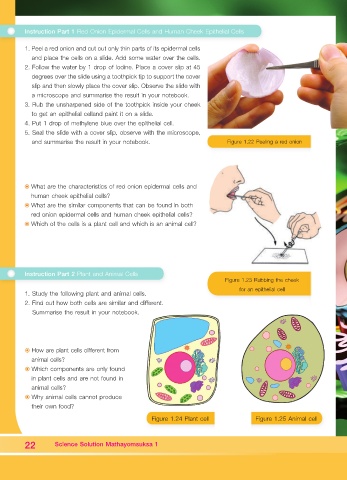
Instruction Part 1 Red Onion Epidermal Cells and Human Cheek Epithelial Cells

          1. Peel a red onion and cut out only thin parts of its epidermal cells
            and place the cells on a slide. Add some water over the cells.
          2. Follow the water by 1 drop of iodine. Place a cover slip at 45
            degrees over the slide using a toothpick tip to support the cover
            slip and then slowly place the cover slip. Observe the slide with
            a microscope and summarise the result in your notebook.
          3. Rub the unsharpened side of the toothpick inside your cheek
            to get an epithelial celland paint it on a slide.
          4. Put 1 drop of methylene blue over the epithelial cell.
          5. Seal the slide with a cover slip, observe with the microscope,
            and summarise the result in your notebook.                         Figure 1.22 Peeling a red onion


            What are the characteristics of red onion epidermal cells and
            human cheek epithelial cells?
            What are the similar components that can be found in both
            red onion epidermal cells and human cheek epithelial cells?
            Which of the cells is a plant cell and which is an animal cell?


          Instruction Part 2 Plant and Animal Cells
                                                                              Figure 1.23 Rubbing the cheek

          1. Study the following plant and animal cells.                           for an epithelial cell
          2. Find out how both cells are similar and different.
            Summarise the result in your notebook.


            How are plant cells different from
            animal cells?
            Which components are only found
            in plant cells and are not found in
            animal cells?
            Why animal cells cannot produce
            their own food?
                                                     Figure 1.24 Plant cell              Figure 1.25 Animal cell


          22        Science Solution Mathayomsuksa 1

