


Page 17 - ตัวอย่าง Science Solution 1
P. 17
3. Protoplasm
                 Protoplasm is colourless fluid component in a cell
          membrane. It consists of fluid part called cytoplasm and other
          very small components or structures called organelles, such as
          a nucleus and mitochondria. Chloroplasts and vacuoles are found
          more commonly in plants cells.


          4. Cytoplasm

                 Cytoplasm is a jelly-like fluid within a cell
          found next to the cell membrane and surrounding
          parts of the nucleus. This fluid consists not only of
          water but also water-soluble substances, such as
          proteins. The smaller essential units within cytoplasm,
          are the following:

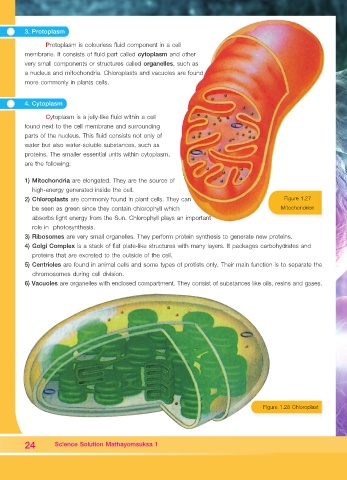
          1) Mitochondria are elongated. They are the source of
            high-energy generated inside the cell.
          2) Chloroplasts are commonly found in plant cells. They can                              Figure 1.27
            be seen as green since they contain chlorophyll which                                Mitochondrion
            absorbs light energy from the Sun. Chlorophyll plays an important
            role in  photosynthesis.
          3) Ribosomes are very small organelles. They perform protein synthesis to generate new proteins.
          4) Golgi Complex is a stack of flat plate-like structures with many layers. It packages carbohydrates and
            proteins that are excreted to the outside of the cell.
          5) Centrioles are found in animal cells and some types of protists only. Their main function is to separate the
            chromosomes during cell division.
          6) Vacuoles are organelles with enclosed compartment. They consist of substances like oils, resins and gases.


                                                                                           Figure 1.28 Chloroplast


          24        Science Solution Mathayomsuksa 1

