


Page 18 - ตัวอย่าง Science Solution 1
P. 18
5. Nuclei

                 Nuclei are structures situated in the middle of cells. Most cells have nuclei, except some types of cells,
          such as red blood cells in mammals and phloems in plants.


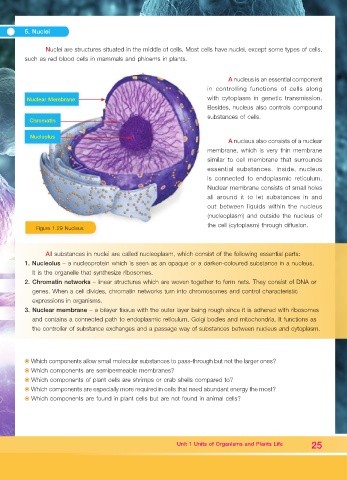
                                                                               A nucleus is an essential component
                                                                        in controlling functions of cells along
          Nuclear Membrane                                              with cytoplasm in genetic transmission.
                                                                        Besides, nucleus also controls compound
                                                                        substances of cells.
           Chromatin

           Nucleolus
                                                                               A nucleus also consists of a nuclear
                                                                        membrane, which is very thin membrane
                                                                        similar to cell membrane that surrounds
                                                                        essential substances. Inside, nucleus
                                                                        is connected to endoplasmic reticulum.
                                                                        Nuclear membrane consists of small holes
                                                                        all around it to let substances in and
                                                                        out between liquids within the nucleus
                                                                        (nucleoplasm) and outside the nucleus of

             Figure 1.29 Nucleus                                        the cell (cytoplasm) through diffusion.


                 All substances in nuclei are called nucleoplasm, which consist of the following essential parts:
          1. Nucleolus – a nucleoprotein which is seen as an opaque or a darken-coloured substance in a nucleus.
            It is the organelle that synthesize ribosomes.
          2. Chromatin networks – linear structures which are woven together to form nets. They consist of DNA or
            genes. When a cell divides, chromatin networks turn into chromosomes and control characteristic
            expressions in organisms.
          3. Nuclear membrane – a bilayer tissue with the outer layer being rough since it is adhered with ribosomes
            and contains a connected path to endoplasmic reticulum, Golgi bodies and mitochondria. It functions as
            the controller of substance exchanges and a passage way of substances between nucleus and cytoplasm.


            Which components allow small molecular substances to pass-through but not the larger ones?
            Which components are semipermeable membranes?
            Which components of plant cells are shrimps or crab shells compared to?
            Which components are especially more required in cells that need abundant energy the most?
            Which components are found in plant cells but are not found in animal cells?


                                                              Unit 1 Units of Organisms and Plants Life     25

