


Page 20 - ตัวอย่าง Science Solution 1
P. 20
All types of organisms, both plants and animals, consist of smallest components, which are cells. But
          these cells are still different in details, e.g. plant cells have cell walls to strengthen the cells, but animal cells do
          not have cell walls. Moreover, plant cells contain chloroplasts used in photosynthesis, but animal cells do not
          have these chloroplasts. Besides small units within cells, other differences between plant and animal cells are
          overall characteristics and shapes of both cells. Most plant cells are rectangular in shape while most animal
          cells are round and irregular in shape.


                1.4       The Relationship between Shape and Function of Cells


                 Animals and plants are made of different types of cells. Each cell type has a unique shape and
          charactertic that is suitable for the function.


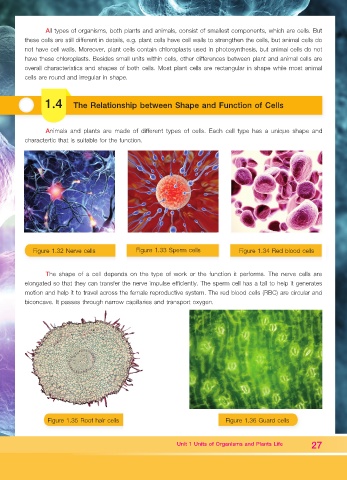
            Figure 1.32 Nerve cells             Figure 1.33 Sperm cells            Figure 1.34 Red blood cells


                 The shape of a cell depends on the type of work or the function it performs. The nerve cells are
          elongated so that they can transfer the nerve impulse efficiently. The sperm cell has a tail to help it generates
          motion and help it to travel across the female reproductive system. The red blood cells (RBC) are circular and
          biconcave. It passes through narrow capillaries and transport oxygen.


                 Figure 1.35 Root hair cells                                  Figure 1.36 Guard cells


                                                              Unit 1 Units of Organisms and Plants Life     27

