


Page 14 - ตัวอย่าง Science Solution 1
P. 14
Kids Need
                  TO KNOW


                 In 1932, two German scientists named
          Max Knoll and Ernst Ruska invented an electron
          microscope that enabled observations on small objects.
          Later in 1950, the electron microscope was enhanced
          to enable observations on objects that are as small as
          0.0005 micrometres and smaller details of the objects
          within a cell. Modern electron microscopes have up to
          500,000 times of magnifying powers.


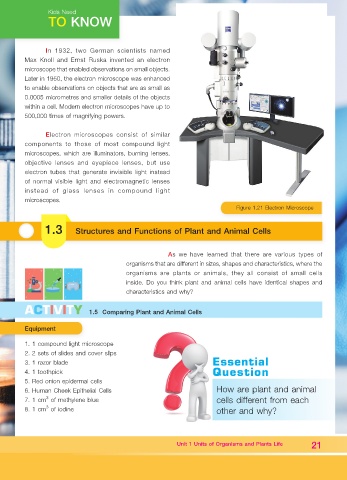
                 Electron microscopes consist of similar
          components to those of most compound light
          microscopes, which are illuminators, burning lenses,
          objective lenses and eyepiece lenses, but use
          electron tubes that generate invisible light instead
          of normal visible light and electromagnetic lenses
          instead of glass lenses in compound light
          microscopes.
                                                                                  Figure 1.21 Electron Microscope


                1.3        Structures and Functions of Plant and Animal Cells


                                                           As we have learned that there are various types of
                                            organisms that are different in sizes, shapes and characteristics, where the
                                            organisms are plants or animals, they all consist of small cells
                                            inside. Do you think plant and animal cells have identical shapes and
                                            characteristics and why?


                                1.5  Comparing Plant and Animal Cells

          Equipment

          1. 1 compound light microscope
          2. 2 sets of slides and cover slips
          3. 1 razor blade
          4. 1 toothpick
          5. Red onion epidermal cells
          6. Human Cheek Epithelial Cells                                  How are plant and animal
                 3
          7. 1 cm  of methylene blue                                       cells different from each
                 3
          8. 1 cm  of iodine                                               other and why?


                                                              Unit 1 Units of Organisms and Plants Life     21

