


Page 3 - ตัวอย่าง Science Solution 1
P. 3
1.1        Unicellular and Multicellular Organisms


                 Living organisms in this world are plants, animals and protists, both microscopic and macroscopic in
          sizes. The organisms may consist of only single cell or millions of cells. Classifying these organisms into groups
          using different criteria will result in having many types. If numbers of cells are used to classify these organisms,
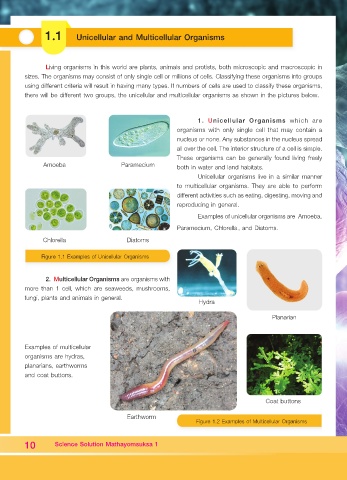
          there will be different two groups, the unicellular and multicellular organisms as shown in the pictures below.


                                                                     1. Unicellular Organisms which are
                                                              organisms with only single cell that may contain a
                                                              nucleus or none. Any substances in the nucleus spread
                                                              all over the cell. The interior structure of a cell is simple.
                                                              These organisms can be generally found living freely
                Amoeba                     Paramecium         both in water and land habitats.
                                                                     Unicellular organisms live in a similar manner
                                                              to multicellular organisms. They are able to perform
                                                              different activities such as eating, digesting, moving and
                                                              reproducing in general.

                                                                     Examples of unicellular organisms are  Amoeba,

                                                              Paramecium, Chlorella, and Diatoms.
                Chlorella                    Diatoms


               Figure 1.1 Examples of Unicellular Organisms


                 2.  Multicellular Organisms are organisms with
          more than 1 cell, which are seaweeds, mushrooms,
          fungi, plants and animals in general.                      Hydra


                                                                                              Planarian


          Examples of multicellular
          organisms are hydras,
          planarians, earthworms
          and coat buttons.


                                                                                            Coat buttons

                                             Earthworm
                                                                    Figure 1.2 Examples of Multicellular Organisms


          10        Science Solution Mathayomsuksa 1

